Pattern: Kirby’s Dream Buffet Amigurumi

Pattern by Lily – Felicity Fiber Crafts

Have you played Kirby’s Dream Buffet yet?? The game is super cute and super fun! I was so excited for it to release that I crocheted a chonky Kirby of my own. I want to share the chonky Kirby love, so I’ve released the pattern here for free! Please enjoy creating your own Dream Buffet Kirby amigurumi, and tag me on social media if you create one! 🙂 (my twitter is @felifibercrafts and my insta is @felicityfibercrafts 😀 )

Stitches and techniques used:

  • Magic ring
  • Single crochet
  • Sewing
  • Needle felting (or other method of applying a face)

Materials used:

  • One skein of worsted/aran weight pink yarn (I used Red Heart Super Saver in Perfect Pink)
  • One skein of worsted/aran weight red yarn (I used Big Twist Value in Varsity Red)
  • **A small amount of either 100% acrylic or 100% wool yarn, or some felting roving in these colors:
    • Dark pink (for his cheeks)
    • Black
    • White
    • Blue (for his eyes)

**Note, you can substitute needle-felting his face for cutting pieces out of felt sheets and gluing or sewing them on. You could also embroider his face if you prefer. 

Notions used:

  • 4mm crochet hook
  • Scissors
  • Polyfill stuffing 
  • Tapestry needle for sewing and weaving in ends
  • Size small needle-felting needle for his face
  • Sewing pins
  • Removable stitch marker  

Gauge:

Not very important for this pattern 🙂  (Although if you use a significantly thinner/thicker “worsted” weight yarn, your Kirby may look off… For instance, Caron Simply Soft is a very thin “worsted” weight yarn, and Caron One Pound tends to be thicker… Keep this in mind when choosing a yarn to use, and adjust your hook size if Kirby isn’t looking the way you want!)

Stitches and Techniques Explained

  • MR – Magic Ring
    • A method for beginning a flat round. You may substitute for any method you like. 
  • inc – increase
    • Place two (or more) stitches in the same stitch. 
  • dec – decrease
    • I use the invisible decrease method. To do this, place your hook in the front loop only of the next stitch, from bottom to top. Then place your hook into the front loop of the next stitch, from bottom to top. There should be three loops on your hook. Yarn over and pull through the first two loops, then yarn over and draw through the remaining two loops. You have decreased by one stitch. 
  • Working in the round
    • When I work in the round, I always offset my increases and decreases on even-numbered rows in order to make a smoother circle. So, for row 4 of the body, I wrote the instructions like this:

4. *sc 2, inc* repeat 6 times (24 st)

But what I actually work is this:

4. sc, inc, *sc 2, inc* repeat 5 times. sc. (24 st)

Likewise for row 6 of the body, the instructions are:

6. *sc 4, inc* repeat 6 times (36 st)

But what I actually work is this:

6. sc 2, inc, *sc 4, inc* repeat 5 times. sc 2. (36 st)

You can see that I “split” the first group of sc in half, which offsets all of the increases for this round. Offsetting the increases like this makes for a smoother circle, and I recommend you do it for every even numbered increase and decrease row. (But it isn’t required.) If my explanation wasn’t clear enough, please try searching online for “how to crochet a perfect circle” and hopefully you will find a better explanation. 🙂

  • Sewing pieces together:
    • I recommend following this tutorial here: https://www.supergurumi.com/how-to-sew-amigurumi-parts-together 
    • I roughly do this, although sometimes I have to split the stitches I sew into. I also don’t mark the entire area with pins, I just keep my piece pinned down until I am done. I recommend going slow and steady to keep the pieces from shifting.

Pattern:

Body:

Using pink:

  1. 6sc in MR (6 st)
  2. inc in each st (12 st)
  3. *sc, inc* repeat 6 times (18 st)
  4. *sc 2, inc* repeat 6 times (24 st)
  5. *sc 3, inc* repeat 6 times (30 st)
  6. *sc 4, inc* repeat 6 times (36 st)
  7. *sc 5, inc* repeat 6 times (42 st)
  8. *sc 6, inc* repeat 6 times (48 st)
  9. *sc 7, inc* repeat 6 times (54 st)

10 – 19.   sc in each stitch (for 10 rows total) (54 st)

20. *sc 7, dec* repeat 6 times (48 st)

21. *sc 6, dec* repeat 6 times (42 st)

22. *sc 5, dec* repeat 6 times (36 st)

23. *sc 4, dec* repeat 6 times (30 st)

24. *sc 3, dec* repeat 6 times (24 st)

25. *sc 2, dec* repeat 6 times (18 st)

Stuff body firmly

26. *sc, dec* repeat 6 times (12 st)

Finish stuffing if needed 

(seriously, stuff this super firm to get a nice round shape)

27. *dec* repeat 6 times (6 st)

BO, leave a long tail and close hole with tail.

Arms (make 2):

Using pink: 

  1. 4sc in MR (4 st)
  2. inc, sc, inc, sc (6 st)

BO and leave a long tail for sewing. Trim the first tail from MR to around 3 inches (7.5cm) and stuff into his hand with back of crochet hook. 

**Note. If his hands are too small for your liking, please add a round of sc to increase height. 

Feet (make 2):

Using red:

  1. 6sc in MR (6 st)
  2. *3sc in first st, 2sc in next st, 1sc in next stitch* repeat once more (12 st)
  3. sc, dec, dec, sc 2, dec, dec, sc (8 st)

BO and leave a long tail for sewing. Trim the first tail from MR if needed and stuff into his foot (shoe?) with back of crochet hook. 

Carefully pin the hands and feet to the body according to the picture and then sew. 

Brief Needle Felting Tutorial:

I am no expert at needle felting, so if you are brand new then I recommend finding a tutorial video or blog post online first. I will explain how I needle felt the faces. 

**Note, I usually use acrylic yarn and split the plies to make roving. I find this method is a lot smoother than using the roving from a needle felting kit. (But I have more colors in the kit, so sometimes I mix and match). The instructions say to split acrylic yarn, but if you already have wool roving then you can just use that. It’s up to you. 🙂

  1. Take a small amount of black acrylic yarn and split the plies. Pull them apart and fluff them so that they resemble wool roving. 
  2. Take a small amount of the black roving and roll it between your fingers until a small oval is formed. (You want this to be around the size of his eye. A little bigger than a grain of rice.)
  3. Place the oval on Kirby’s face where you would like an eye to be. Start gently poking the oval with the felting needle. Be careful to poke the needle directly up and down– any wiggling or changing angle could break the needle. 
  4. Once the oval is sticking to Kirby’s face, create another one for the other eye and gently poke it onto Kirby’s face. It is much easier to make adjustments, or pull the felt off and start over, when the felt is only lightly stuck on his face. 
  5. Add more roving as needed, adjust the shape, you can even remove the felt and start again if needed. Do this until you are happy with the shape and placement of Kirby’s eyes.
  6. Continue gently poking the felt until the surface is smooth and securely stuck to Kirby.

For pink Kirby, his eyes will be black at this point.

  1. Take a small amount of the blue acrylic yarn and split the plies to make roving. 
  2. Take a very small amount of roving and roll into a ball shape. The ball should only be around 3mm in diameter. You don’t want this to be too big. 
  3. Gently poke the roving in a small circle towards the bottom of his eyes. Be very gentle, because if you poke too hard, you’ll poke all of the roving into his eye. The needle should only go about 5mm deep at most. 
  4. Repeat step 9 for the other eye. Be careful to make the eyes even. Once you are pleased with their shape and size, lightly poke all over to secure the blue felt to the black. The surface should be smooth and the blue felt should not easily fall off. 

For pink Kirby, his eyes will have blue dots at this point.

  1. Now take a small amount of white acrylic yarn. Make roving out of it the same way you have been, and pull an even tinier amount to make a little ball in your fingers. The diameter should only be around 2mm. 
  2. Carefully and gently poke the white ball onto the upper area of his eye. Repeat for the other eye. Adjust as needed, and continue poking it to smooth and secure it once you are pleased with the shape and size. 
  1. You can stop at this point, or you can add the two little extra shines by repeating steps 11 and 12 (but with even tinier balls of roving)

With the additional eye shines.

  1. Take a small amount of the dark pink acrylic yarn and split the plies to make roving. 
  2. Take a small amount of the roving and roll it into an oval shape between your fingers, slightly smaller than the eyes were. 
  3. Place this on Kirby’s face according to the image and lightly poke to secure it. Repeat for the other side. Make adjustments as needed, and once you are happy, finish poking the cheeks to secure and flatten them. 
  1. Take a small amount of black acrylic yarn and split the plies. Take one of the plies and trim it to be around the length of Kirby’s mouth (a little larger since it will shrink as you poke). Gently untwist the ply a little to fluff it, but don’t pull the ply apart to make roving. 
  2. Start poking the mouth onto Kirby, starting with the corners and then the lowest point of his smile. Continue poking to make the curved shape and secure the mouth. 
  3. Optionally, you can add a tiny amount of roving to fill out the corners of his mouth some. I think it adds a cute effect. 

Kirby’s completed face! 

Please note for pink Kirby, his cheeks will be dark pink.

**Final notes: Personally I am not a fan of needle felting faces. I almost always have to redo pieces, and it winds up getting very frustrating. But the result is so worth it in my opinion. I just wanted to mention this in case it frustrates you too. You are not alone :’)

Congrats, you are done!! 🙂
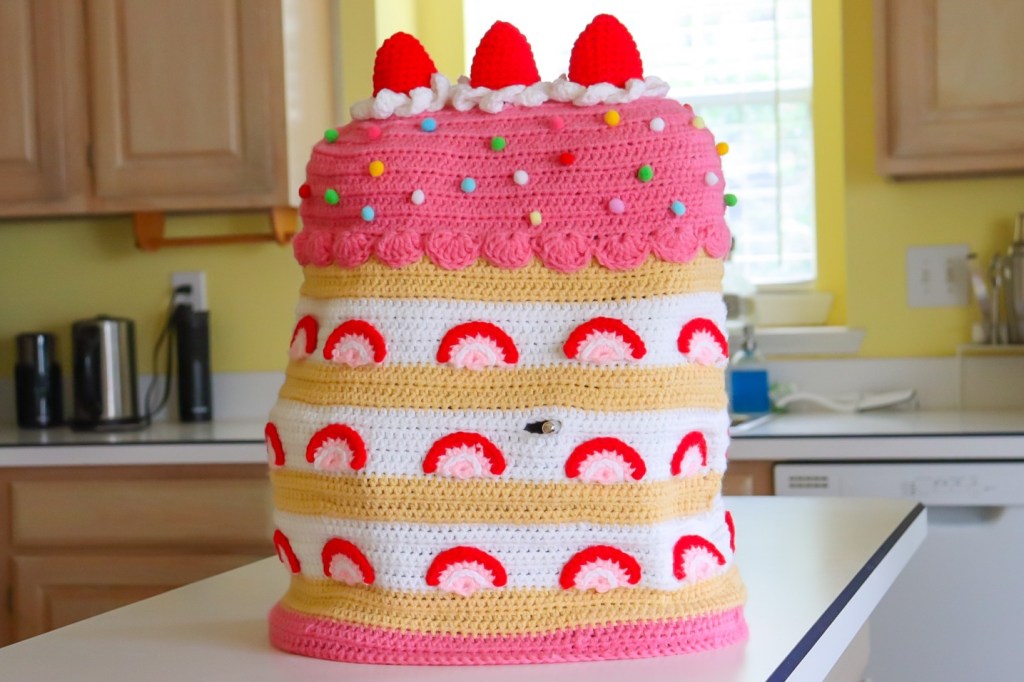
Project Post: Strawberry Shortcake Stand-Mixer Cover by Twinkie Chan

I have always wanted to make a Twinkie Chan pattern— seriously since I was, like, 12!! I’m so glad that I’ve finally learned to crochet so I can finally make some of her super cute stuff.

I had got my partner a black stand-mixed for Christmas a few years back (it would’ve been light pink, but alas there were none in stock 🙁). When I saw this pattern, I knew I had to make it right away! Introducing the Strawberry Shortcake Stand-Mixer pattern by Twinkie Chan!

The finished stand-mixer cover

I am soooo happy with how it turned out! It’s seriosuly so cute, and so worth the effort! I followed her pattern exactly, and it came out perfect! I’m glad for that, since I’ve seen other folks’ come out too big for their mixer.

This was such a fun project to make, and it was so fun to put together! There were a TON of ends to weave in though. I found that utilizing some Gorilla brand hot glue made attaching everything much easier!

I’d love to know, have you made a Twinkie Chan pattern before? Tell me about it in the comments below!

Pattern Review: Winding Ridges Cowl by Janet Pippin

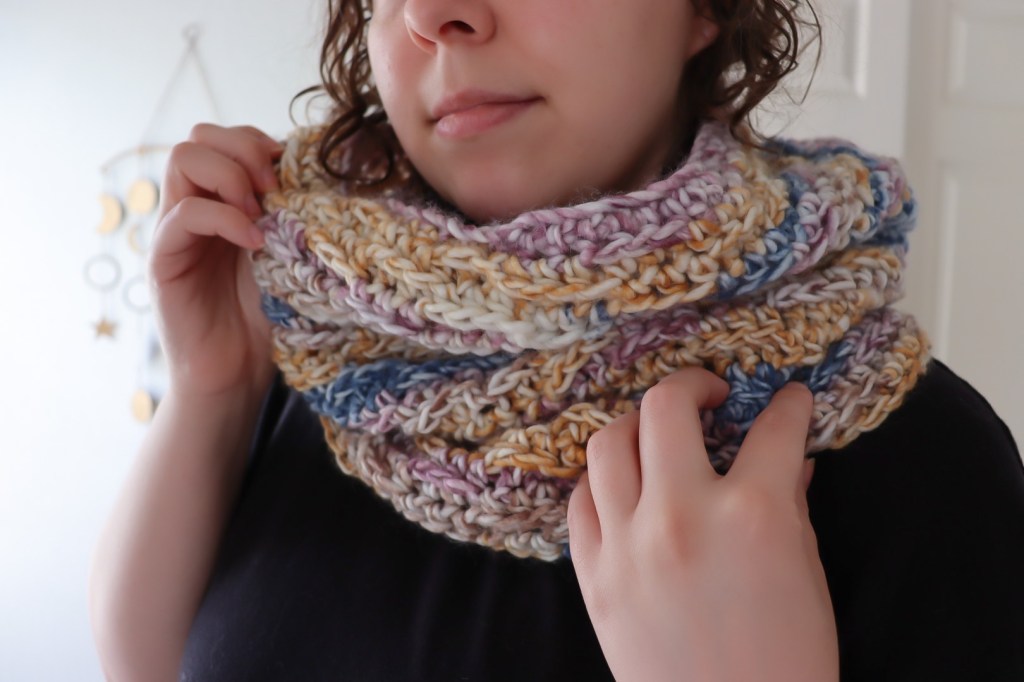
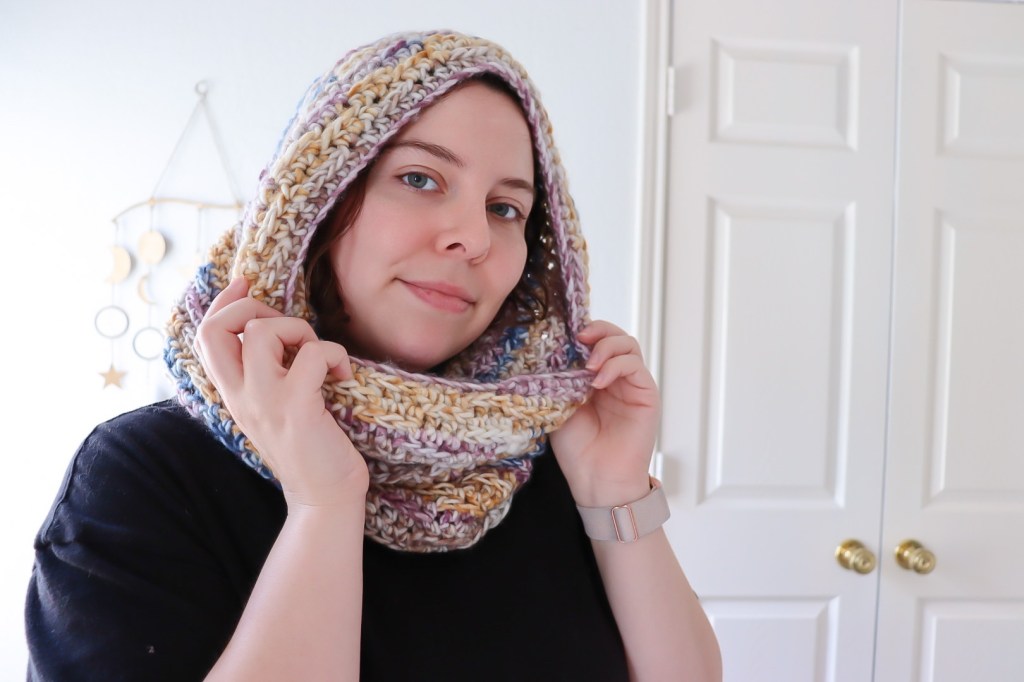
I’m actually not certain of the differences between a shawl, a cowl, a scarf, a wrap, etc, etc. All I understand is that they tend to keep your neck warm, and sometimes other parts too! What drew me to this pattern, was that if the cowl is made long enough, it can double as a hood! So I grabbed my Lion Brand Mandala Watercolors yarn and got to work to create the Winding Ridges Cowl by Janet Pippin.

The completed cowl

This pattern was a lot of fun to make. I was super excited to work with this yarn, and the pattern was composed of all half double crochet— which is my favorite basic stitch! By alternating working in the normal loops and the hidden third loop, one can create an interesting texture out of a simple stitch!

A closer view of the stitch pattern

I really wanted to show off the yarn, and this stitch pattern added just enough interest to do so!

I had a bit of trouble with lining up my stitches at the beginning of each round, but I started to figure it out well enough. I could end up telling if my stitches weren’t lined up properly after crocheting a few inches of the round. I found a good solution was to mark my first stitch with a stitch marker!

As I made the cowl, I was sure to try it on periodically. I wanted the cowl to be long enough to cover my head as a hood, but not too long that I couldn’t use it around my neck. I ended up using almost exactly two cakes of yarn to get the cowl just right!

Wearing the cowl as a hood

Overall, I’m very pleased with how this turned out. It’s warm, it’s cute, and it’s versatile! I’m super excited for the colder weather so I can wear this around more!

Have you made this cowl before? Or tell me about your favorite cowl pattern! 🙂

Pattern Review: Easy Peasy Posy Shawl by The Crochet Fix

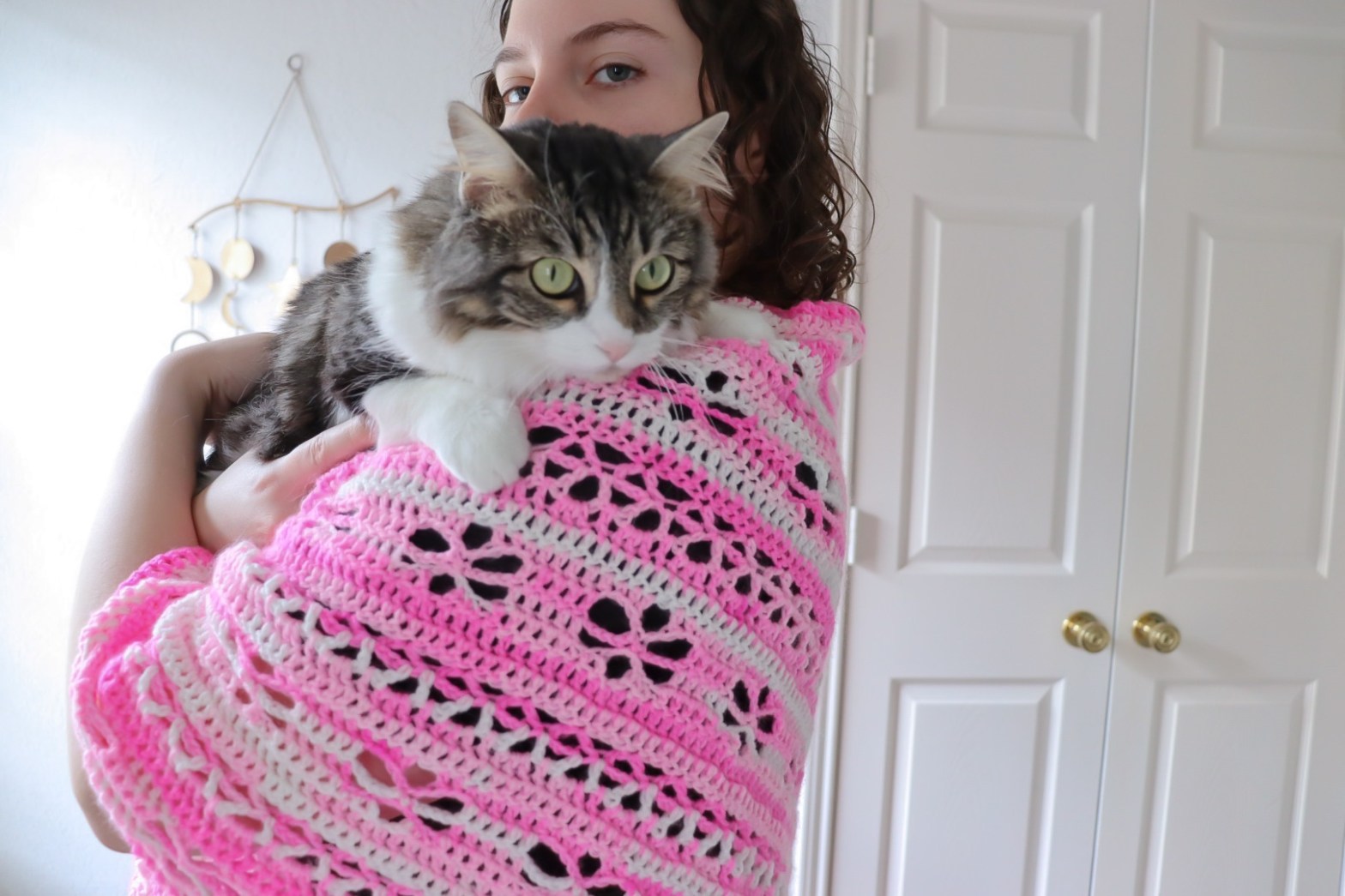
Frequently, I buy yarns without having a project in mind. I then browse through Ravelry, looking under the projects tab of the yarn I just bought, hoping for inspiration. That is how I stumbled upon the Easy Peasy Posy Shawl by The Crochet Fix. I had just purchased Lion Brand Ice Cream yarn, and thought it would look great as this shawl!

The finished shawl

The pattern can be purchased from Ravelry, or accessed for free on the original blog website. I ended up purchasing the pattern since it came with images and diagrams! (But the free blog post gives plenty enough information in my opinion)

This shawl has some cute floral filet work, with some lattice rows that also look like little flowers! It makes a great light spring shawl since it’s airy too.

The pattern was very detailed and well written. It’s a 10-row repeat pattern, but it goes row by row until two repeats are completed. This really helped me understand how the pattern would repeat in subsequent rows!

One might think this pattern isn’t beginner friendly, but I disagree! Surprisingly, the complexity of the rows actually makes it easier to catch mistakes quicker, so not as much rework is required. Each row’s stitch pattern is actually quite easy to remember once you’ve completed it a few times. I truly think an adventurous beginner would be able to complete this pattern fine.

The completed shawl ft. my cat Athena

Overall I really liked this pattern. It’s enjoyable to create, and the finished product is super cute. The instructions were clear, and there’s even a free version of the pattern! I really like how this turned out.

Have you made this shawl before? What did you like about it??

Blog: I learned to knit!

You might never guess that my yarn crafting journey started over 10 years ago when I first tried to learn to knit. Fast-forward 3 years to my trying to learn again. Then another 5 years to my trying to learn AGAIN! Finally, I realized that self-teaching just wasn’t going to cut it, and I signed up for a 3-session class at my local yarn store.

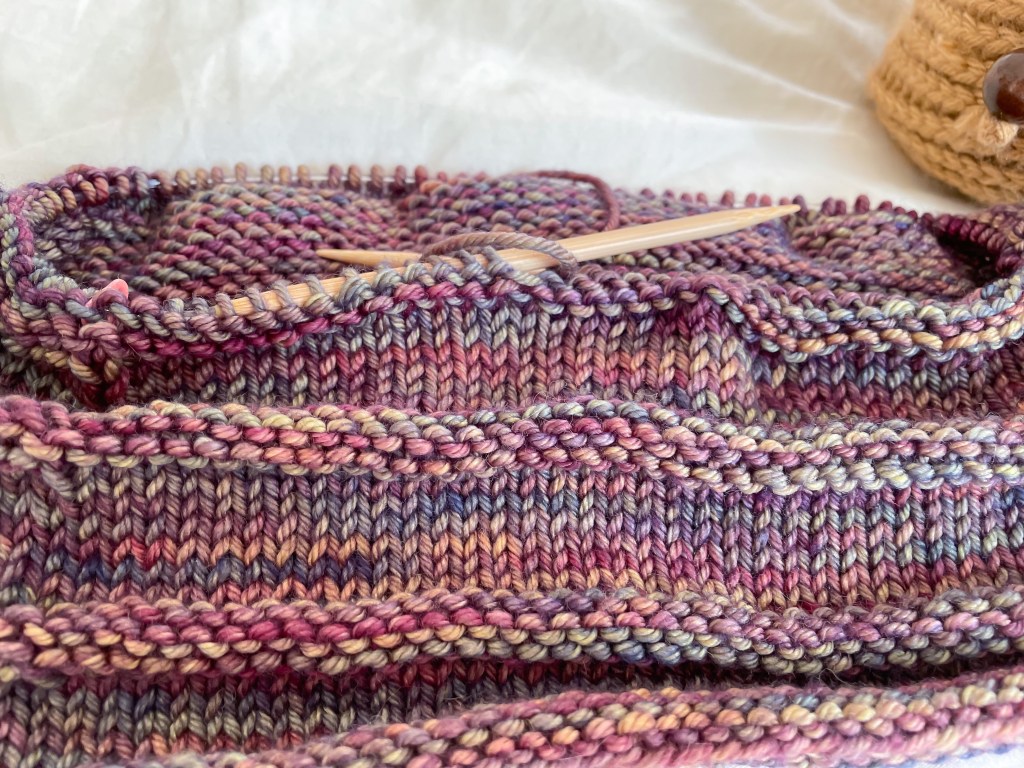
A closeup of my first real knitting project

I really think that learning to crochet helped me learn to knit. Practicing crochet taught me how to look at the yarn and actually see the stitches I was making. Plus, I’ve found that continental knitting is much easier for me, and it’s also a very similar style to crochet.

I remember being intimidated by crocheting, so much so that I didn’t even want to learn how to use a hook to pick up dropped knit stitches! My discomfort with crochet held me back from knitting, and I’m glad I realized just how great crocheting is!

On the question of whether crocheting is easier than knitting, I’d honestly have to agree. I find that crochet is very beginner friendly. Mistakes are easy to undo and recover from, and using just one hook can be a lot less intimidating that using two (or more!) needles.

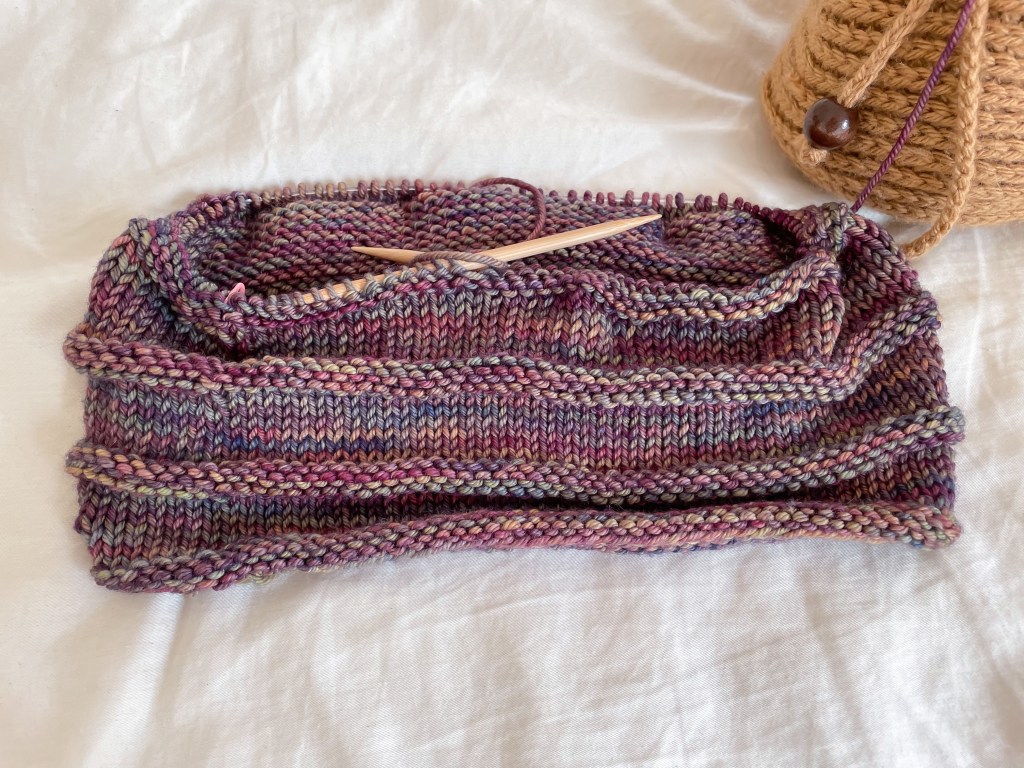
My current knitting project— I’m making a cowl

If you’re struggling to learn to knit, I highly recommend finding a class at your local craft or yarn store. Even just going in and asking someone for help can be beneficial! I’m glad I’ve finally learned to knit, and I’m excited to make all sorts of projects!

Pattern Review: Easy Breezy Shawl by PurpleIguana

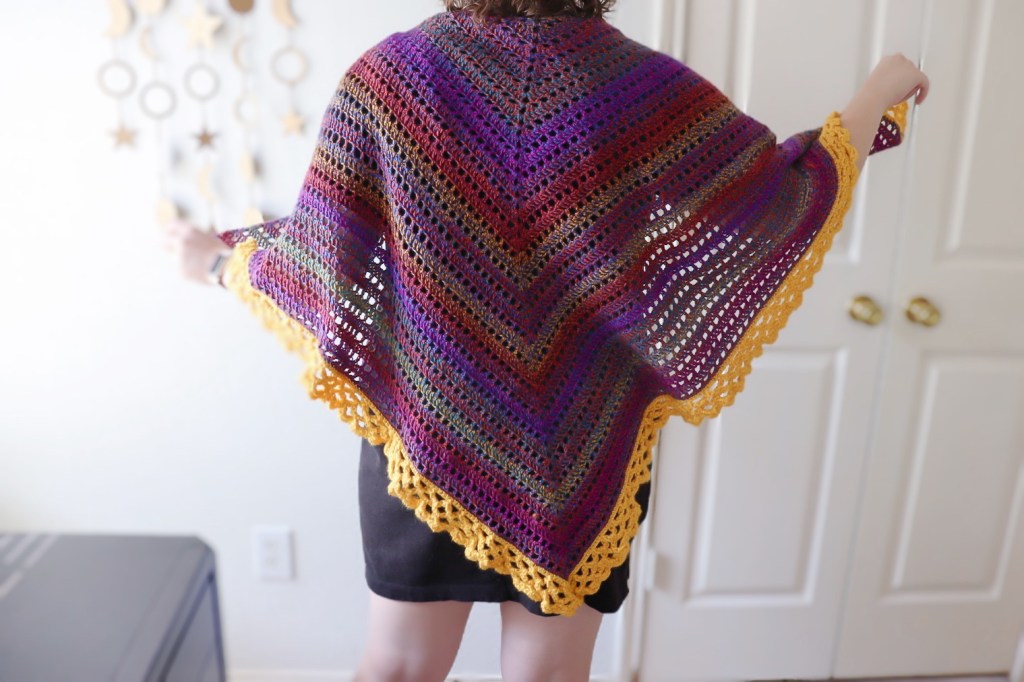
I hadn’t made a shawl before, and I wanted a simple one to teach me the basics. Plus, I had just got some lovely Lion Brand Moroccan Nights yarn that I wanted to show off! After much searching, I found what I wanted: the Easy Breezy Shawl pattern by PurpleIguana on Ravelry.

The completed shawl

This pattern is very simple, just a two-row repeat using only double crochet and chain stitches. Due to the simple nature, I actually made quite a few mistakes! I found it easy to accidentally miss a stitch when I was rounding the corner, which would lead to me pulling out the whole row once I realized.

I chose this pattern because of its simplicity. I knew that the yarn I was using wouldn’t have any stitch definition, and I really just wanted to show off the yarn! This pattern achieved that perfectly, in my opinion.

The pattern didn’t include a border, so I found a design in one of my crochet books. I used a shiny golden colored yarn for the border since I wanted to give this shawl a mystical, royal look!

The finished shawl

Overall, I’m super pleased with how this project turned out. The shawl is light, but still warm. I think it’ll look great during autumn or winter with other rich, dark colors.

I really want to know, what was your first crochet shawl?

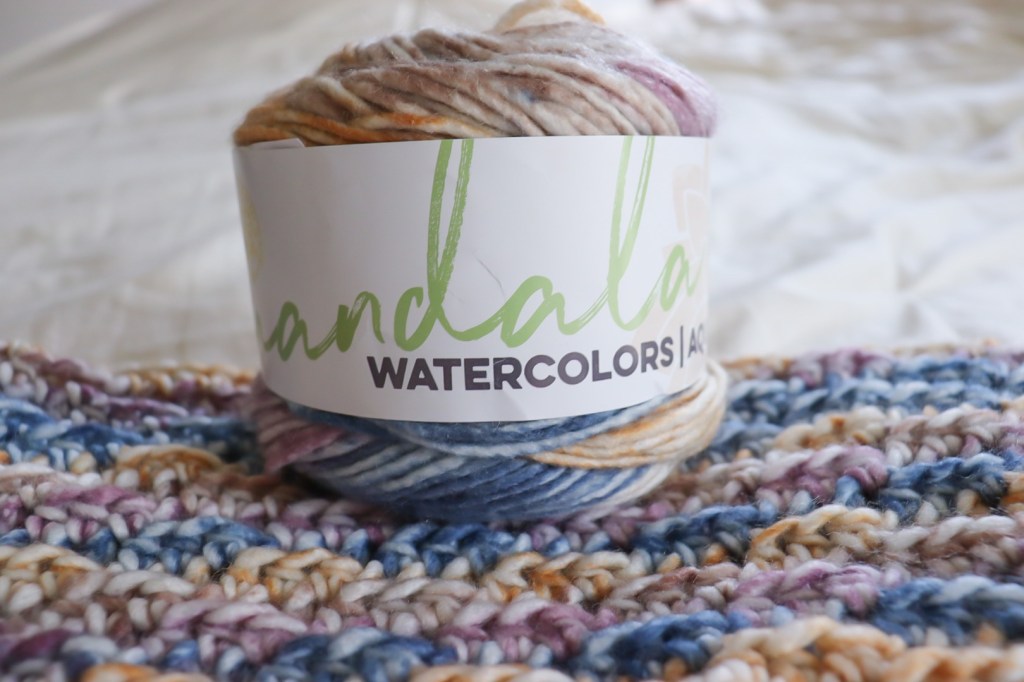
Yarn Review: Lion Brand Mandala Watercolors

Ahhh, Lion Brand’s Mandala– a favorite among many crocheters and knitters. I’ve always been fascinated with the Mandala yarns, but I couldn’t decide which to start with! Finally, the Mandala Watercolors went on sale at my local craft store and I just couldn’t pass it up.

This yarn is a bulky roving style, with the colored fibers just barely covering the white core. This gives that lovely translucent effect of watercolor paints. I fell in love with the pansy colorway, the reddish-purple combined with a dark blue and burnt orange reminded me of the morning sky on a prairie.

The yarn is soft and squishy and easy to work with. Since it’s roving style, there’s no splitting strands to worry about. Now, I’m not sure if this is related to the roving yarn, or if this is specific to Mandala Watercolors, but I found that the yarn was quite fuzzy, and lots of stray fuzz would float around while I worked– and even get stuck behind my glasses! It wasn’t all that bothersome, but just something to keep in mind. 🙂

Overall, I really enjoyed working with this yarn. I honestly don’t have much to say since it was really just a nice experience. The colors were beautiful to work with, the yarn was soft on my hands, there weren’t any issues with tangling or splitting… It was really a great yarn!

All in all, I’ll give this yarn 5/5 stars! The stray fibers was the only negative I had, and it really wasn’t that bad. 🙂 I really want to use this yarn again sometime– and try other Mandala yarns too!

Have you used Mandala Watercolors? Or any other Mandala yarns? Let me know how you liked it!

Yarn Review: Lion Brand Ice Cream

I found this yarn in the baby section at my craft store, although I don’t think it is necessarily baby yarn! I was drawn to the bright pink “Birthday Cake” color– so bright that it almost hurt my eyes to look at! I knew I wanted to wear this yarn the moment I saw it.

Lion Brand Ice Cream in Birthday Cake

This yarn is 100% acrylic, and it’s super soft and squishy. It’s DK weight, so lighter than your typical worsted acrylic yarn. The yarn is a little fuzzy, which is typical for a 100% acrylic yarn. This yarn is self-striping, the colors being dark pink, pink, light pink, and white.

Even though the yarn is self-striping, the gradients between colors is actually pretty smooth. It produces a lovely effect when crocheted into a fabric.

Like most self-striping yarns, this looks best when crocheted in rows rather than the round, but I think it also looks good when crocheted into a triangular shawl!

This particular color way might be a bit “young” for some people, but there are many other colors to choose from!

All in all, I really like this yarn so far. It’s soft and feels nice on the hands, plus the colors are so bright and cute. I’m looking forward to finishing my project with this yarn, and I may buy some more in the future!

Have you used Lion Brand Ice Cream yarn before? Let me know how you liked it!

Yarn Review: Lily Sugar ‘n Cream

Summer is here, which means it’s time to put down the cozy wool and alpaca yarns and pick up some more breathable yarn— like cotton! Lily Sugar ‘n Cream has many different cotton yarns in their lineup, and today I’ll be reviewing the original 100% cotton yarn.

Lily Sugar n’ Cream yarn

If you’ve never used a 100% cotton yarn before, you may be surprised at how it feels. It’s stronger and heavier than wool and acrylic, feels a bit rougher, and has almost no fuzz. For those reasons, cotton yarn gives excellent stitch definition! Cotton is also a breathable fabric, so it wears cooler than most wools and acrylics. Lastly, cotton is very absorbent, whereas wool and acrylic are not.

Something I find to be negative about this yarn is that it has the tendency to split while you are working with it. This makes it difficult at times to maneuver the hook, especially when doing more complex stitches like the puff stitch.

Lily Sugar n’ Cream is one of the only brands of 100% cotton yarn I’ve seen at my craft stores, so I cannot really compare it to other yarns. For that reason, this post may read more as a review of 100% cotton yarn in general, rather than Lily Sugar ‘n Cream specifically. 🙂 Still, I hope this information will be helpful!

Yarn Review: Lion Brand Moroccan Nights

I fell in love with this yarn at first sight. The swatch at my local craft store was so beautiful, and when I saw the yarn go on sale I couldn’t resist buying some!

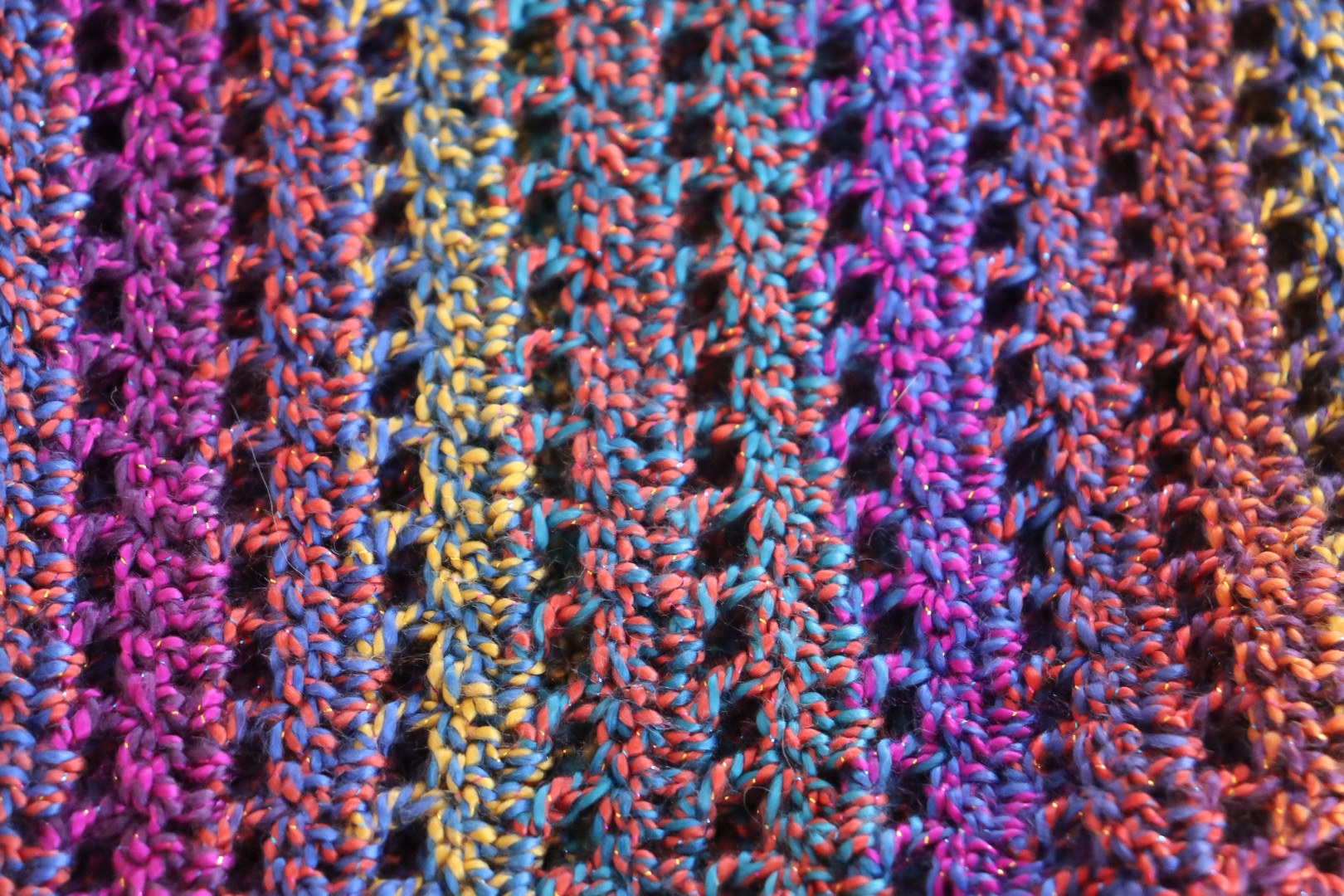
A close up of Moroccan Nights yarn

This yarn is a unique gradient made up of two different colored strands. Each strand gradually changes colors throughout the skein which gives this yarn a flowing and magical effect. There’s also a metallic strand spun through the yarn which adds a bit of sparkle.

The Moroccan Nights yarn is marked as DK weight, but I found that the weight slightly varied throughout the skein as the colors shifted.

The yarn is not too fuzzy, but the colors are very visually busy, so almost all stitch definition is lost— this is definitely a yarn that shines with simpler stitches! The yarn also twists a bit when you unravel it, but I found that it didn’t end up tangling too bad! (I also wound the yarn into a cake before working, so that could’ve also been a reason for no tangles)

The yarn feels just a little rough in the hands. I can’t describe it, but it was just a bit uncomfortable! Maybe due to the metallic thread spun throughout? However, I did get used to it after a while.

The yarn’s colors are so beautiful, this was absolutely a joy to work with! Overall I really enjoyed using Moroccan Nights, and I really want to try using it again sometime!

To summarize:

  • The yarn is not very fuzzy, but the colors are very busy
  • The yarn doesn’t produce clear stitch definition
  • The yarn twists and splits a bit, and might have the tendency to tangle (although I didn’t have that issue!)
  • The yarn feels a little rough in the hands
  • The colors are so beautiful!!

Overall I give this yarn a 4/5 stars! Even though it has a few negatives, the colors are so beautiful and unique that I would still go through some trouble just to use the yarn again.

Have you used Lion Brand: Moroccan Nights yarn before? Tell me about your experience with it!

Design a site like this with WordPress.com
Get started